
United States · Guide · Updated 2026-09-29
Hip protectors vs airbag vest: which fall protection for seniors?
Hip protectors and airbag vests both aim at the same injury, the hip fracture that follows a sideways fall, but they work very differently. Hip protectors are passive pads worn in special underwear; an airbag vest actively detects the fall and inflates before impact around the hips, back and head. This comparison covers protected zones, mechanism, comfort and adherence, cost, and limits, so that families and caregivers can choose, or combine, the two.
Why the hip is the target
Nearly 319,000 older Americans are hospitalized for hip fractures every year, and in 2019, 83% of hip-fracture deaths and 88% of hip-fracture emergency visits and hospitalizations were caused by falls (CDC). A hip fracture often means surgery, months of rehabilitation and, for many, a loss of independence. Both products exist because the energy of a sideways fall concentrates on the greater trochanter, the bony point on the side of the hip.
Hip protectors: how they work, strengths, limits
Hip protectors are shields or soft pads (foam, gel, energy-absorbing polymers) held over each hip by fitted underwear or shorts. They absorb or redistribute part of the impact. Strengths: no electronics, no charging, low cost ($40 to $150 per pair, several pairs needed for laundry rotation), no false triggers.
Limits: they protect only the hips; nothing for the back, the pelvis' other zones or the head, and falls are the most common cause of traumatic brain injury in older adults. Their real-world benefit depends entirely on adherence: the pads have to be worn, correctly positioned, at the moment of the fall, including at night and in the bathroom, which is where many falls happen. Studies in nursing homes have reported meaningful protection when adherence is high and little effect when it is not. Comfort, heat and toileting difficulties are the usual reasons people stop wearing them.
Airbag vest: how it works, strengths, limits
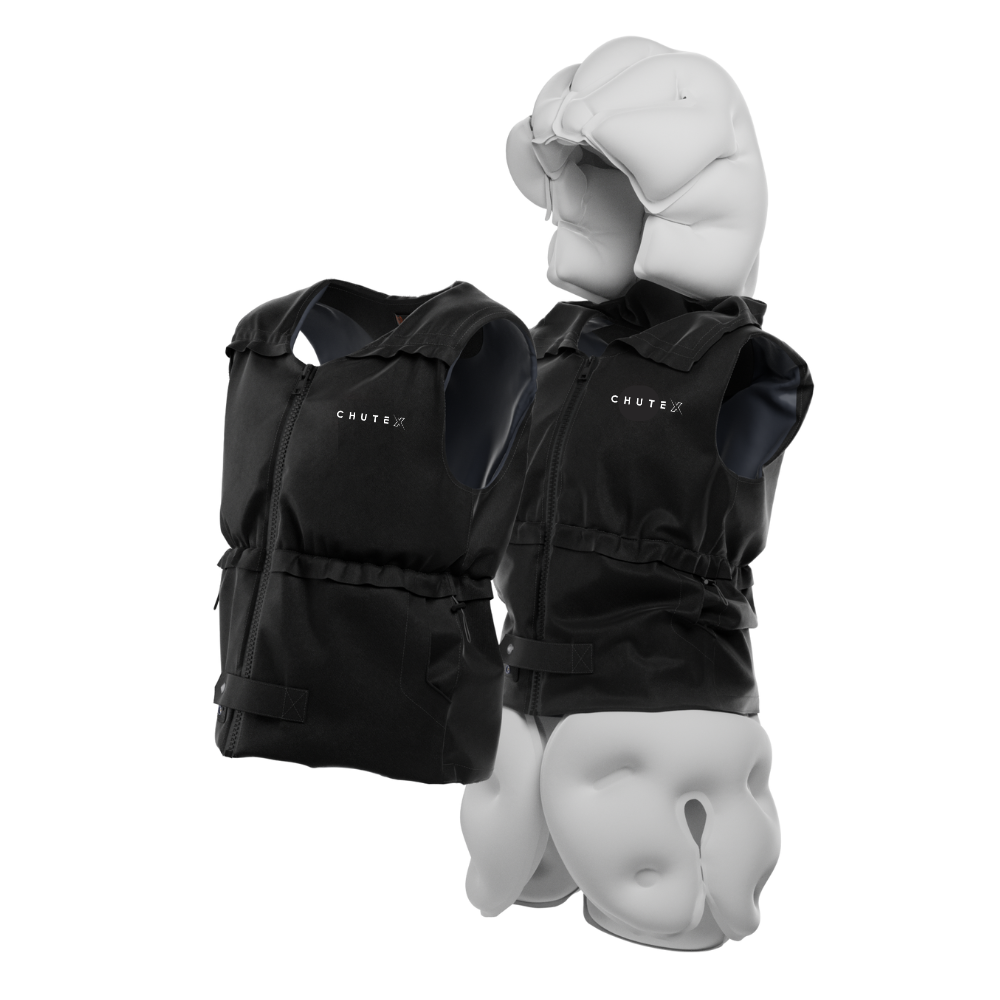
A wearable airbag vest such as the Chutex Elder carries motion sensors that recognise the signature of a fall and trigger gas cartridges, inflating chambers around the hips, the lower back and the head before impact. Strengths: it protects several zones at once, it is worn over clothing so adherence is easier, and it can notify configured caregivers through the app after a deployment. It is reusable after a 30-second cartridge change.
Limits: higher price ($879 for Elder in the US, plus cartridges per deployment), a battery to charge, and an algorithm that, like any detection system, cannot catch every event (a very slow slide may not trigger). It does not prevent the fall, does not call 911 and does not treat any condition. Elder is personal protective equipment (CE category II), not a medical device, and it has not been cleared or evaluated by the FDA.
Side-by-side
Protected zones: hip protectors, hips only; airbag vest, hips, lower back and head. Mechanism: passive padding vs active detection and inflation. Adherence: underwear that must be worn correctly at all times vs a vest over clothing. Alerts: none vs caregiver notification via app (Elder). Maintenance: laundry vs charging and cartridge replacement after deployment. Cost: $40–150 per pair vs $879 (no VAT, free US shipping). Regulatory status: neither is a medical device; neither is FDA-cleared; both are protective equipment.
Who should choose what
Hip protectors suit people in supervised settings where staff can ensure they are worn, people who cannot manage charging, or as a low-cost first step. An airbag vest suits people living at home who want continuous protection while staying active, people whose falls are sudden and unbroken (Parkinson's, neuropathy, drop attacks), and post-surgery recovery. Combining both is possible. In every case, prevention comes first: balance exercise, medication review, vision and home safety (CDC STEADI), and a way to call for help fast: 911 and, if wanted, a medical alert service.
Frequently asked questions
What is a hip airbag?
« Hip airbag » is the everyday name for a wearable airbag that inflates over the hips when a fall is detected. It comes as a belt (hips only) or as a vest such as the Chutex Elder, which also covers the lower back and head. Like hip protectors, it aims at the hip fracture that follows a sideways fall; unlike them, it is active and worn over clothing.
Are hip protectors effective for elderly people?
They can reduce hip-fracture risk when worn correctly at the moment of the fall; the evidence is strongest in supervised settings with high adherence. They protect only the hips and do nothing for head or back injuries.
Is an airbag vest better than hip protectors?
It protects more zones (hips, back, head), is worn over clothing and can notify caregivers, but it costs more and relies on detection. Neither prevents falls. The right choice depends on the person's situation, and the two can be combined.
How much do hip protectors and airbag vests cost?
Hip protectors cost about $40 to $150 per pair, with several pairs needed. The Chutex Elder airbag vest costs $879 in the United States (no VAT, free shipping) plus replacement cartridges after each deployment.
Are hip protectors or airbag vests covered by Medicare?
Neither is durable medical equipment in the usual sense and Chutex makes no reimbursement claim. Check with your plan administrator about any HSA/FSA eligibility.
Is the Chutex Elder airbag vest FDA-approved?
No. It is personal protective equipment (CE category II) designed in France, not a medical device; it has not been cleared or evaluated by the FDA.
Related
Elder airbag vest for elderly people: the fall vest that inflates before impact · Airbag vest for elderly people: how it works, who it is for, what it costs · Fall protection for seniors at home: a practical US guide · All US guides · Chutex United States