United States · Guide · Updated 2026-10-14
Heart rate variability (HRV): what it means, normal ranges and how to raise it
In short resting recordings of healthy adults, a review pooled by Nunan and tabulated by Shaffer and Ginsberg puts mean RMSSD at 42 milliseconds (standard deviation 15), with a cross-study range of 19 to 75. A 24 hour recording and a wearable night score are not that number. Medical review in progress.
What heart rate variability measures
Heart rate variability is the variation in time between heartbeats, not the beats per minute themselves. Shaffer and Ginsberg, in Frontiers in Public Health (2017), describe RMSSD as the root mean square of successive differences between normal heartbeats. You take each gap between beats in milliseconds, square the differences, average them, then take the square root. They call RMSSD the primary time-domain measure used to estimate vagally mediated changes in heart rate variability.
The same paper says the conventional minimum recording for RMSSD is 5 minutes. Researchers have also proposed ultra-short windows of 10, 30, and 60 seconds. Those windows are not the same measurement as a 24 hour recording. Shaffer and Ginsberg write that 24 hour values and short-term values are calculated with the same formulas but cannot substitute for each other, because slower rhythms, including sleep and wake, contribute only to the longer recording.
A single RMSSD on a watch or a ring is one method among those. It is not a diagnosis, and it is not the clinical 5 minute electrocardiogram the norms below describe. This information does not replace advice from a health professional. Medical review in progress.
Normal HRV ranges
| Measure | Mean (SD) | Range across studies | Studies |
|---|---|---|---|
| RMSSD (ms) | 42 (15) | 19 to 75 | 15 |
| SDNN (ms) | 50 (16) | 32 to 93 | 27 |
Nunan and colleagues reviewed short-term heart rate variability studies published from January 1997 to September 2008. The abstract of that PACE 2010 paper says 44 studies met their criteria and included 21,438 participants. Values were lower than the older Task Force norms. They also report large differences between individuals, especially for spectral measures, and they say the numbers should be used with the method in mind: age, sex, habitual activity, editing of the beat intervals, and who counted as healthy.
Shaffer and Ginsberg reprint the Nunan short-term table. For RMSSD the mean is 42 milliseconds, the standard deviation is 15, and the range across the 15 studies that reported it is 19 to 75 milliseconds. SDNN, a broader time-domain measure, has a mean of 50 milliseconds (standard deviation 16) across 27 studies, range 32 to 93. There is no row in that table labeled good, normal for athletes, or normal at night.
What is a good heart rate variability score, then, is not a single cutoff. A value inside 19 to 75 can still be ordinary for a short resting recording, and a value outside it can come from a different method. The papers do not convert RMSSD into a 0 to 100 readiness score.
Heart rate variability by age
| Age (years) | SDNN (ms) | rMSSD (ms) |
|---|---|---|
| 10 to 19 | 176 ± 38 | 53 ± 17 |
| 20 to 29 | 153 ± 44 | 43 ± 19 |
| 30 to 39 | 143 ± 32 | 35 ± 11 |
| 40 to 49 | 132 ± 30 | 31 ± 11 |
| 50 to 59 | 121 ± 27 | 25 ± 9 |
| 60 to 69 | 121 ± 32 | 22 ± 6 |
| 70 to 79 | 124 ± 22 | 24 ± 7 |
| 80 to 99 | 106 ± 23 | 21 ± 6 |
Umetani and colleagues recorded 24 hour time-domain heart rate variability by decade. Heart rate variability fell with age, and the shape of the fall depended on the measure. SDNN and SDANN declined gradually and reached 60 percent of the second-decade baseline by the tenth decade. rMSSD and pNN50 fell faster, reaching 47 percent and 24 percent of baseline by the sixth decade, then leveled off. The paper says that after age 60 the rMSSD decline slowed and then stabilized, at 40 percent of baseline by the tenth decade.
The 43 millisecond rMSSD mean at ages 20 to 29 is close to the 42 millisecond short-term mean in the Nunan table. That closeness is not a reason to treat them as the same test. One number is a 24 hour recording. The other is a short resting recording pooled across studies.
Before age 30, heart rate variability was lower in female subjects than in male subjects on every measure they used. The rMSSD and pNN50 sex difference disappeared after age 30. Differences on the other measures lasted until about age 50, then disappeared. The paper does not print a separate normal band for women in the decade table above, so this page does not invent one.
Shaffer and Ginsberg also summarize later 24 hour work. Almeida-Santos and colleagues, in adults aged 40 to 100, found a linear decline in SDNN and a U-shaped pattern for RMSSD and pNN50: down from 40 to 60, then up after 70. That sample included people with conditions such as dyslipidemia and hypertension who could still do daily activities. It is not a second healthy-adult chart, and this page does not copy their means.
What a low heart rate variability means
Low, in the Umetani paper, is first an age pattern. Healthy people over 65 can sit below cutpoints that other papers had tied to a higher risk of death. For 24 hour rMSSD, 12 percent of subjects older than 65 fell below a published cutpoint of 15 milliseconds. For pNN50, 14 percent fell below 0.75 percent. For the SDNN index, 25 percent fell below 30 milliseconds. The authors say normal aging can push these measures under those lines, which limits how useful the lines are in older adults. They are not a wearable alert.
A low night score on a band can also be a different measurement: a shorter window, a different sensor, or a night that included waking. Shaffer and Ginsberg say lower high-frequency power is correlated with stress, panic, anxiety, or worry. They do not give a millisecond threshold for that statement. This page does not add alcohol, caffeine, or dehydration as causes, because those words are not in the passages read.
Almeida-Santos and colleagues concluded that global autonomic regulation was lower in men, in people with diabetes, and in people with obesity, inside a sample that already included other conditions. That is an association in their recordings, not a diagnosis you can make from one morning.
How to raise heart rate variability
Shaffer and Ginsberg write that, in healthy people, respiratory sinus arrhythmia can be increased by slow, deep breathing. Their example is concrete: slow the breath to 6 breaths per minute and the heart-rate fluctuations should be larger than at 15 breaths per minute, while mean heart rate should not change much, because vagal tone (the average heart-rate shift) did not change. A larger swing is not the same thing as a higher 24 hour rMSSD, and it is not a promise that a wearable score will rise by a set number of milliseconds.
The papers read for this page do not publish an exercise dose that raises RMSSD by a stated amount. Umetani mentions differences in activity as one possible reason the decline is faster in the second decade. That is a hypothesis in the discussion, not a training plan. Shaffer and Ginsberg note that right after aerobic exercise, heart-rate recovery involves parasympathetic reactivation while sympathetic activity is still elevated. That describes the minutes after effort, not a higher resting score the next morning.
There is no Chutex program that promises a higher heart rate variability. If you want a comparable series, use the same device, the same time of night, and several nights. Do not mix a 5 minute seated test, a 24 hour hospital recording, and a ring score in one average.
Night HRV from a wearable
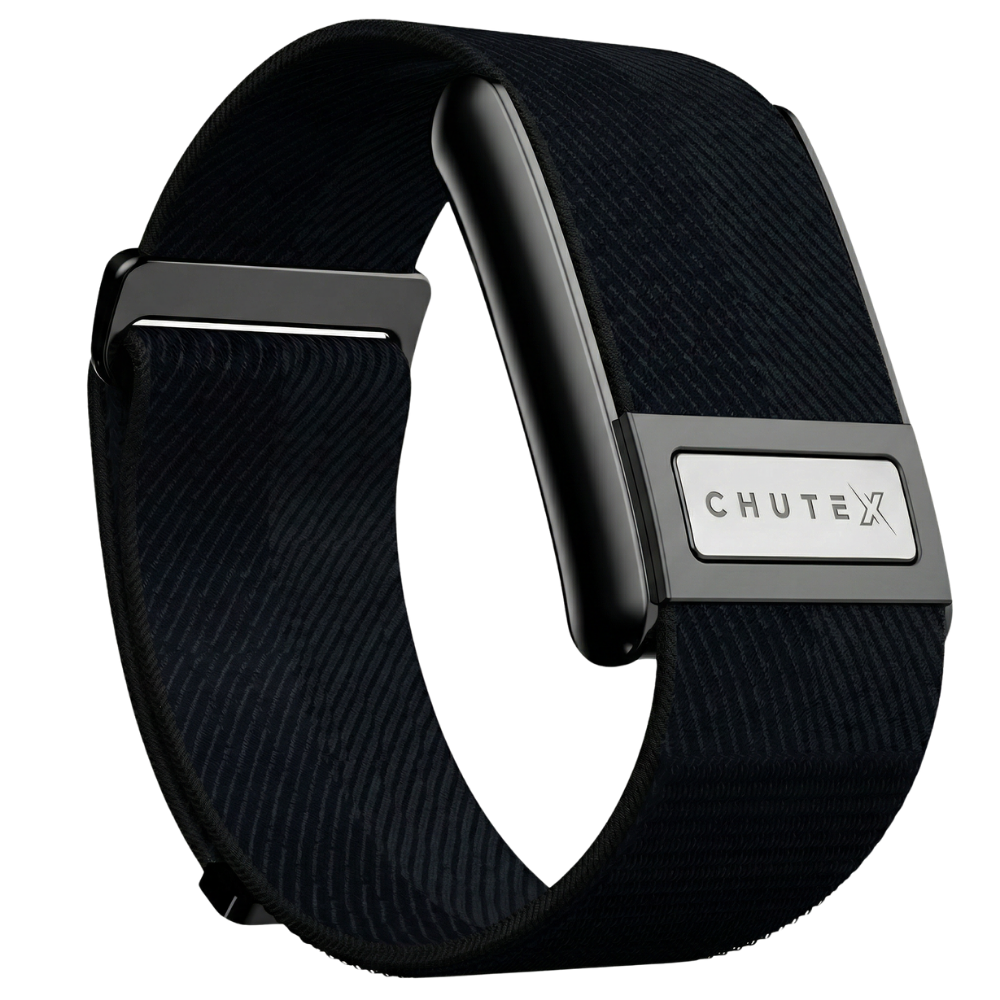
Elio is a screenless wellness band. On the US product page read on 14 October 2026 it is described as tracking sleep and heart rate variability trends, with a single-lead ECG and recovery insights in the Chutex app. The same page says the battery life is 15 days. The price shown there is 264 US dollars, one-time. Elio is not a medical device. It is not FDA-cleared and it has not been evaluated by the FDA. It provides wellness estimates, not a diagnosis.
A night trend from Elio is useful for comparing your nights with each other. It is not the Nunan 5 minute mean of 42 milliseconds, and it is not the Umetani 24 hour table. The app can show the series. It cannot tell you that a low night is disease.
In an emergency in the United States, call 911. Medical teleconsultation with Chutex is currently available in France. Medical review in progress.
Frequently asked questions
What is heart rate variability?
Heart rate variability is the change in the time between heartbeats. Shaffer and Ginsberg describe RMSSD as the root mean square of those successive differences, usually from a recording of at least 5 minutes. It is not the same number as your heart rate in beats per minute.
What is a good HRV?
There is no single good score in the sources read for this page. For short resting recordings, Shaffer and Ginsberg tabulate a Nunan mean RMSSD of 42 milliseconds, standard deviation 15, range 19 to 75 across studies. A wearable night value is a different method.
What is a normal HRV for my age?
Umetani and colleagues report 24 hour rMSSD means of 43 milliseconds at ages 20 to 29, 31 at 40 to 49, 22 at 60 to 69, and 21 at 80 to 99, each with a standard deviation in the table on this page. Those are full-day electrocardiogram means in healthy subjects, not a target for a ring or a band.
What is a normal HRV?
Normal depends on the recording. Short-term RMSSD in the Nunan review, as reprinted by Shaffer and Ginsberg, centers on 42 milliseconds with a wide range. The 24 hour means from Umetani fall with age. Neither table is a 0 to 100 score.
Why is my HRV low?
Age lowers 24 hour heart rate variability in the Umetani sample, and some healthy adults over 65 fall below older mortality cutpoints without that page calling the result a disease. A wrist or finger sensor can also read low because the window, the night, or the device is not the lab test. One low night is not a diagnosis.
What does low heart rate variability mean?
In the research read here, a low 24 hour value can be the expected age pattern, and lower high-frequency power has been correlated with stress, panic, anxiety, or worry. Shaffer and Ginsberg do not attach a millisecond cutoff to that sentence. A consumer device does not turn the correlation into a diagnosis.
How to improve HRV?
Shaffer and Ginsberg say slow breathing, about 6 breaths per minute, can enlarge respiratory sinus arrhythmia compared with 15 breaths per minute, without much change in mean heart rate. They do not state how many milliseconds a wearable score should gain. This page does not add an exercise prescription.
Does HRV improve with fitness?
The sources read here do not give a fitness program or a promised rise in RMSSD. Umetani mentions activity level as one possible reason the age decline is steeper early in adulthood. That is not a measured training effect. Compare nights recorded the same way, and talk to a clinician if the change worries you.
Related
Elio screenless wellness band ($264, one-time) · Normal resting heart rate: chart by age and sex, and when to see a doctor · Oura Ring alternatives in 2026: smart rings and bands without a monthly fee · Whoop alternatives in 2026: screenless trackers without a membership · How much deep sleep do you need? Normal amounts, and how to get more · VO2 max: chart by age and sex, how to measure it, how to improve it · REM sleep: what it is, how much you need, and what affects it · Best HRV monitor in 2026: chest straps, rings and screenless bands compared · All US guides · Chutex United States