United States · Guide · Updated 2026-10-14
How much deep sleep do you need? Normal amounts, and how to get more
NHLBI calls stage 3 deep sleep, or slow-wave sleep, and says you usually spend more of it early in the night. Adults are advised to sleep 7 to 9 hours in total. That is not a deep sleep quota. Ohayon's 2004 meta-analysis found the share of slow-wave sleep falls with age and does not set a required number of minutes. Medical review in progress.
How much deep sleep you need
The National Heart, Lung, and Blood Institute describes sleep as two phases, rapid eye movement (REM) and non-REM sleep. A cycle starts over every 80 to 100 minutes, and a night usually has four to six cycles. You may wake briefly between cycles. Non-REM sleep has three stages, defined by brain activity recorded in a sleep study.
Stage 1 is the transition between wakefulness and sleep. Stage 2 is sleep. Stage 3 is the stage NHLBI calls deep sleep or slow-wave sleep, named for a pattern in those brain activity measurements. You usually spend more time in stage 3 early in the night. The pages read on 14 October 2026 do not convert that description into a required number of minutes or a required percentage of the night.
On the question of total sleep, not deep sleep, NHLBI writes that experts recommend adults sleep between 7 and 9 hours a night. Adults who sleep less than 7 hours may have more health issues than those who sleep 7 or more hours. Sleeping more than 9 hours is not necessarily harmful and may help young adults, people recovering from sleep deprivation, and people who are sick. Those hours include the whole night. They are not a stage 3 target.
This information does not replace advice from a health professional. Medical review in progress.
Deep sleep by age
| Age pattern | What NHLBI says about slow-wave sleep |
|---|---|
| Early childhood | The amount peaks |
| Teenage years | It drops sharply |
| Adulthood | It continues to decrease |
| Older age | A person may have no slow-wave sleep at all |
NHLBI also says newborns spend more time in REM sleep, which is a different phase from stage 3. The slow-wave drop from childhood through older age is the age pattern on that page. It is not a table of hours.
Ohayon, Carskadon, Guilleminault, and Vitiello published a meta-analysis in Sleep in 2004 (PMID 15586779). It pooled 65 studies and 3,577 healthy people aged 5 to 102 years. In children and adolescents, the percentage of slow-wave sleep was significantly and negatively correlated with age. In adults, the percentage of slow-wave sleep decreased with age, along with total sleep time, sleep efficiency, the percentage of REM sleep, and REM latency. After 60 years of age, only sleep efficiency continued to decrease in a significant way. The abstract does not print a percentage or a minute target for any decade, so this page does not invent one.
The same abstract says the size of the age effects changed when studies screened people for mental disorders, organic disease, drugs or alcohol, obstructive sleep apnea, or other sleep disorders. A norm copied from an unscreened sample is not the same object as a norm from a screened one.
For total sleep, including naps, the NHLBI duration page gives other ages. Babies from 4 months to 1 year: 12 to 16 hours a day. Children 1 to 2 years: 11 to 14 hours. Children 3 to 5 years: 10 to 13 hours. Children 6 to 12 years: 9 to 12 hours. Teens 13 to 18 years: 8 to 10 hours. Newborns younger than 4 months vary widely. Naps are considered appropriate under age 7. None of those lines is a deep sleep allowance.
What deep sleep is, and what it is not
Deep sleep, on the NHLBI page, is stage 3. REM sleep is the other phase. During REM, the eyes twitch, brain activity looks similar to waking, dreaming usually occurs, and muscles normally become limp. You usually have more REM later in the night. NHLBI also says you do not have as much REM in colder temperatures, because the body does not regulate its temperature properly during REM. That sentence is about REM, not about stage 3.
So whether REM sleep is deep sleep: no, on this page. REM is not stage 3. NHLBI does not use the phrase light sleep as a stage name. Stage 1 is the transition into sleep. Stage 2 is sleep. Stage 3 is the stage they call deep.
Sleep studies classify phases and stages with sensors that record eye movements and brain activity. A consumer band does not become that study because it shows a stage name.
Why deep sleep can be short
The clearest reason in the sources read here is age. Slow-wave sleep peaks in early childhood, drops in the teenage years, keeps falling in adulthood, and may be absent in older people. Ohayon's meta-analysis agrees that the percentage falls with age, and that after 60 the measure that kept declining in a significant way was sleep efficiency, not a further statement about slow-wave sleep.
NHLBI's overview of how sleep works says internal clocks run on cycles of about 24 hours and are regulated by light, darkness, and sleep schedules. Once you are asleep, you move through the stages in a predictable pattern. The same overview says that not getting enough sleep, or enough quality sleep, raises risk for heart and respiratory problems and affects metabolism and the ability to think clearly and focus. That is a statement about short or poor sleep in general. It is not a count of stage 3 minutes lost to one habit.
The pages read here do not list alcohol, caffeine, a pillow spray, a soundtrack, or a game as a measured cause of low stage 3. Those products show up in search. They are not in the NHLBI passages or in the Ohayon abstract.
How to get more deep sleep
There is no minute gain in the sources read for this page. NHLBI does not prescribe a sound, a spray, or a score to chase. What it does say about timing is that light, darkness, and sleep schedules regulate the clock, and that adults are advised to sleep 7 to 9 hours in total.
If you or a child seem to sleep too much or too little, NHLBI says to talk with a doctor. This page does not add a supplement, a bedtime gadget, or a promise that stage 3 will rise by a stated amount.
How to increase deep sleep naturally is the same limit. Natural, in the pages read here, means the conditions already named: a regular schedule and the light and dark cues around it. It does not mean an untested spray.
What a tracker can show
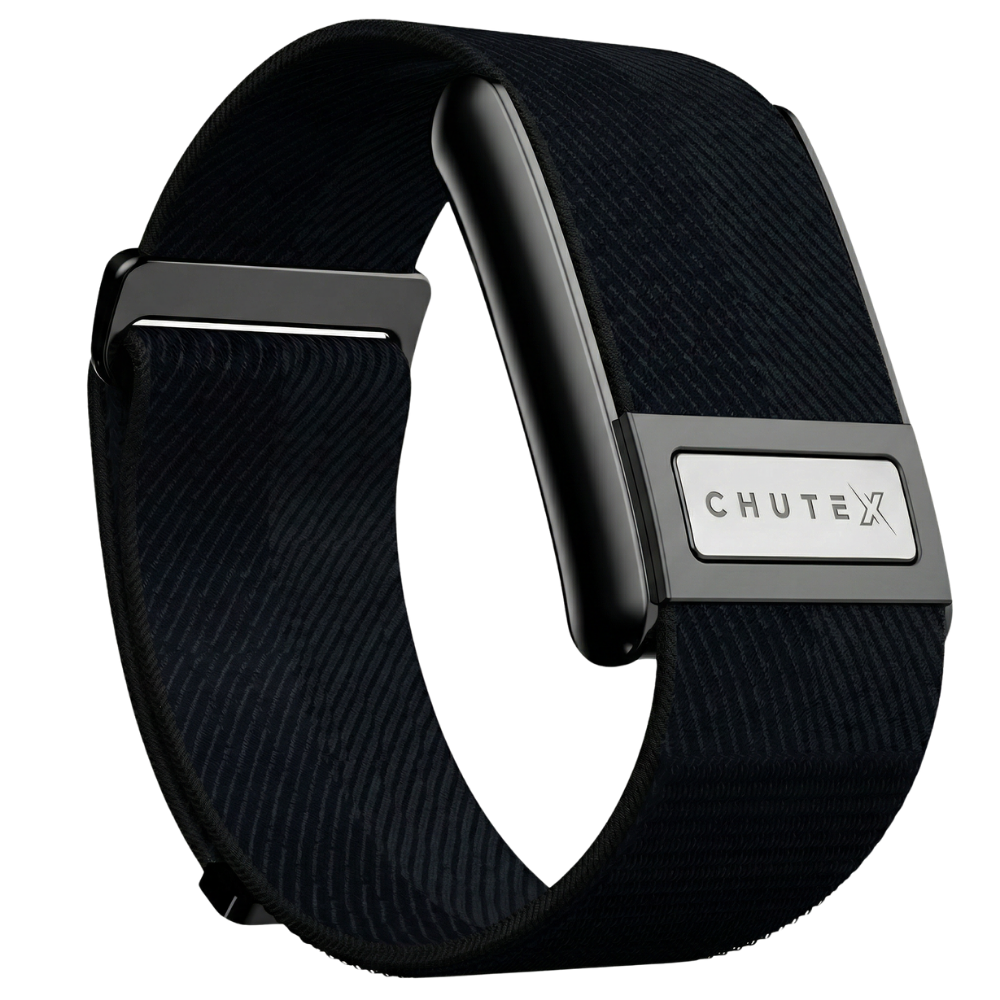
Elio is a screenless wellness band. On the US product page read on 14 October 2026, the pack is 264 US dollars, one-time, with no subscription. Battery life is stated as 15 days. The page says Elio tracks sleep and its stages and estimates other wellness signals. It also says Elio is not a diagnostic device, does not measure glucose, and does not detect disease.
A stage label from that band is a wellness estimate. NHLBI says sleep studies classify stages from eye movement and brain activity sensors. Elio is not that study, and this page does not claim the band's stage 3 matches a laboratory tracing.
In an emergency in the United States, call 911. Medical teleconsultation with Chutex is currently available in France. Medical review in progress.
Frequently asked questions
How much deep sleep do you need?
The NHLBI and Ohayon texts read for this page do not set a required number of minutes of deep sleep. NHLBI calls stage 3 deep sleep and says adults should sleep 7 to 9 hours in total. That total is the whole night, not stage 3 alone.
How much deep sleep should you get a night?
No nightly minute quota is in the sources read here. You usually spend more time in stage 3 early in the night, across four to six cycles of about 80 to 100 minutes. The 7 to 9 hour adult range is total sleep.
How many hours of deep sleep do you need?
This page does not convert stage 3 into hours. Ohayon's abstract reports that the percentage of slow-wave sleep falls with age. It does not print an hour target.
How much deep sleep do you need by age?
NHLBI says slow-wave sleep peaks in early childhood, drops sharply in the teenage years, keeps decreasing in adulthood, and may be absent in older people. Ohayon found the percentage falls with age in 3,577 people aged 5 to 102. Neither source prints a minute chart by birthday.
How to get more deep sleep?
The pages read here do not promise a gain in minutes. They tie the sleep clock to light, darkness, and a sleep schedule, and they give a total sleep range of 7 to 9 hours for adults. Talk with a doctor if sleep seems far outside that range.
Is REM sleep deep sleep?
No. NHLBI calls stage 3 deep sleep or slow-wave sleep. REM is the other phase: more common later in the night, with dreaming and limp muscles. The two are not the same stage.
What is light sleep versus deep sleep?
NHLBI does not use the phrase light sleep as a stage name. Stage 1 is the transition into sleep, stage 2 is sleep, and stage 3 is deep sleep. REM is a separate phase.
Do deep sleep music, pillow sprays, or games increase deep sleep?
Those products are not tested in the NHLBI pages or in the Ohayon abstract read here. This page does not rank them and does not claim they add stage 3.
Related
Elio screenless wellness band ($264, one-time) · Normal resting heart rate: chart by age and sex, and when to see a doctor · Heart rate variability (HRV): what it means, normal ranges and how to raise it · Oura Ring alternatives in 2026: smart rings and bands without a monthly fee · Whoop alternatives in 2026: screenless trackers without a membership · VO2 max: chart by age and sex, how to measure it, how to improve it · REM sleep: what it is, how much you need, and what affects it · Best HRV monitor in 2026: chest straps, rings and screenless bands compared · All US guides · Chutex United States